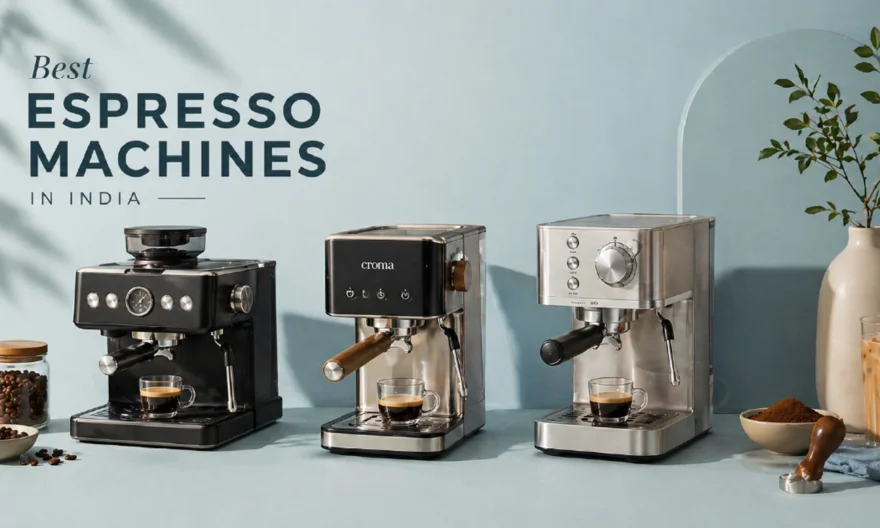
Best Espresso Machines in India 2026
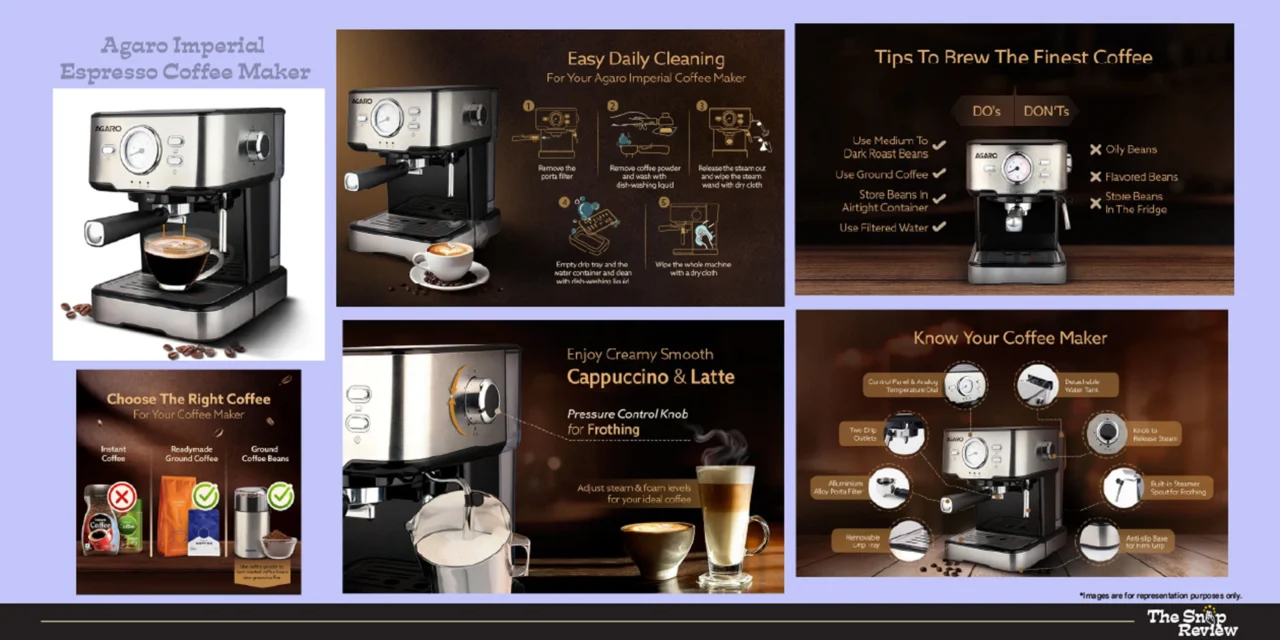
AGARO Imperial Espresso Coffee Maker — Best Overall
Price Range: Rs.10,000 – Rs.15,000
Bar Pressure: 20 Bar
Capacity: 1.2L water tank
Best for: Home users who want reliable espresso with good milk frothing
What We Like –
20-Bar Pressure System: This is the most important number in espresso making. True espresso requires 9 bar pressure at the group head. The 20-bar pump provides enough pressure to the machine to consistently deliver 9 bar pressure even with minor variations in grind size and tamping. Most inexpensive machines claim 15-20 bar pressure at the bars, but in reality deliver only 3-5 bar pressure. The Agaro Imperial actually reaches close to its stated pressure, which results in a rich creamy and accurate extraction.
Dual Temperature System: This is a feature that often goes unnoticed, but it’s crucial for everyday use. Espresso is made at a temperature of 90-96°C. A completely different temperature is best for steaming milk. Many budget machines offer either one or the other. The Agaro Imperial offers both features simultaneously, and the user doesn’t have to wait long between making coffee and steaming – a truly thoughtful design choice for a machine at this price.
Milk Steamer: The Imperial Machine’s steam steamer produces a powerful foam – not a thick, soapy foam like the cheaper machines, but a velvety texture, the kind required for lattes and cappuccinos. It takes a little practice, but it works. We’ve seen machines costing twice as much that produce even worse foam.
Widespread Availability and Service Network: Agaro has established a surprisingly strong presence across India. You can find the Imperial model on Amazon with Prime delivery, customer support is prompt and spare parts are readily available. This is truly commendable for an Indian brand selling home appliances at this price point.
Build Quality for the Price: Strictly speaking, this machine doesn’t feel premium, but it doesn’t feel cheap either. Its build quality is sturdy enough to withstand daily use without any dings or rattles, which is hard to say for many competitors in this range.
What Could Be Better –
Learning Can Take Time: This is a semi-automatic machine, meaning the user controls the timing manually. If you use pod machines or a fully automatic setup, you’ll need some time to adjust. It’s easy to over- or under-shot initially.
Grinder Not Included: This is true for all the machines on this list, but it’s worth noting. For a great espresso, you need freshly ground coffee beans. The Agaro works best when used with a separate burr grinder. Pre-ground coffee also works, but the results are obviously inconsistent.
Warm-Up Time: It takes 2-3 minutes for the machine to reach the right temperature for brewing coffee. This will not take much time in the morning routine, but it does mean you can’t make coffee in 30 seconds, which happens with a press of a button like a pod machine.
Real Talk –
If you want to enjoy authentic espresso at home in India and your budget is less than Rs.15,000, the Agaro Imperial is our unconditional recommendation. The coffee made with this coffee machine tastes exactly like you’d find in a good café — no adulteration or imitation. It’s dual-temperature system, precise pressure and strong steam wand make it far superior to most of the coffeemakers in this price range. Buy it from Amazon India for the best price and excellent after-sales service.
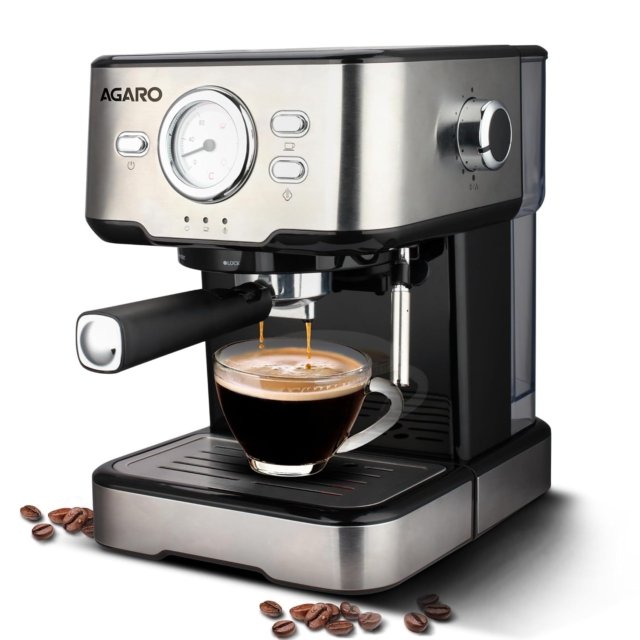
AGARO Imperial Espresso Coffee Maker
Price Range: Rs.10,000 – Rs.15,000
Bar Pressure: 20 Bar
Capacity: 1.2L water tank
Best for: Home users who want reliable espresso with good milk frothing
Disclaimer : We are a product review website providing honest opinions based on extensive research. Prices mentioned are approximate and may vary.
How to Choose the Right Espresso Machine for Your Needs?
Buying an espresso machine is more complex than buying most appliances because the ‘best’ machine genuinely depends on how you plan to use it. Here’s what actually matters:
Bar Pressure — The Most Important Specification
Real espresso requires 9 bars of pressure at the coffee puck. This is not negotiable — it’s physics. Machines that use steam instead of a pump cannot achieve this pressure and produce fundamentally different coffee (it’s not really espresso, regardless of what the label says).
When shopping, look for machines with a pump-driven system. The bar rating on the pump (15-20 bar) is higher than the 9 bars needed because pressure drops between the pump and the coffee — this is normal. What matters is that the machine has a real pump, not just steam pressure.
Semi-Automatic vs Fully Automatic vs Pod Machines
- Semi-Automatic (All machines on this list): You control grind size, dose, tamping, and extraction time. More control, more skill required, more rewarding for coffee enthusiasts. Better coffee ceiling if you invest time to learn.
- Fully Automatic (Bean-to-Cup): Machine handles grinding, dosing, and extraction automatically. Much more convenient, consistently decent results. Significantly more expensive (Rs.40,000–Rs.2,00,000+). Better for people who want reliable coffee without involvement.
- Pod/Capsule Machines (Nespresso, etc.): Maximum convenience, minimum skill required. Good but not great espresso. Ongoing capsule cost is high — typically Rs.30-50 per cup. Environmentally questionable. Good for occasional users who prioritize convenience over quality and cost.
- Grinder — The Purchase You Must Plan For : This point cannot be overstated: the grinder is more important than the espresso machine for coffee quality. Fresh ground coffee makes a dramatic difference. Pre-ground coffee for espresso goes stale within days. Budget at least Rs.5,000–Rs.15,000 for a decent burr grinder alongside your espresso machine purchase. The combination of a mid-range espresso machine with a good grinder will consistently outperform an expensive espresso machine with pre-ground or blade-ground coffee.
Milk Frothing — What You Actually Need
You mainly drink espresso or Americanos: Frothing capability doesn’t matter much. Focus budget on the brewing components.
You want lattes and cappuccinos occasionally: A basic steam wand will do. All machines on this list have one.
Water Quality in India — A Critical Factor
Indian tap water varies enormously in hardness. Mumbai and Delhi have notably hard water that causes scale buildup inside espresso machines. This scale reduces heating efficiency, affects taste, and eventually damages internal components.
- Use filtered water wherever possible — even basic RO-filtered water is better than direct tap water for espresso machines
- Descale your machine every 2-3 months in hard water areas (most brands include descaling solution or recommend branded descalers)
- Consider a water softener attachment (Rs.1,500-3,000) if you live in a very hard water area
- Never use distilled water — it lacks the minerals that carry flavor and can damage rubber seals over time
- Budget Reality Check
Common Mistakes to Avoid
1. Buying on Bar Pressure Alone: A machine claiming 20 bars with a steam-pressure system is misleading advertising. Always check whether the machine has a pump (good) or uses only steam pressure (not suitable for real espresso).
2. Ignoring Ongoing Costs: Beyond the machine cost, budget for: quality coffee beans (Rs.600-1,500 per month for regular drinkers), descaling solution (Rs.500-800 every 2-3 months), a good grinder if not already owned (Rs.5,000+), and occasional maintenance.
3. Expecting Perfect Coffee Immediately: Semi-automatic espresso machines require practice. Your first 20-30 shots will likely be underwhelming. This is normal. The learning process is part of the experience — don’t return the machine after a disappointing first week.
4. Skipping the Grinder: We’ve said this before and we’ll say it again — a Rs.15,000 machine with pre-ground coffee will be consistently outperformed by a Rs.10,000 machine with a Rs.8,000 burr grinder. Good coffee starts with fresh grinding.
5. Neglecting Cleaning: Espresso machines need regular cleaning — back flushing, porta filter cleaning, steam wand purging after every use, and periodic descaling. A neglected machine produces increasingly poor coffee and fails sooner. Budget 5-10 minutes after each use for basic maintenance.
Frequently Asked Questions
Q: What’s the difference between an espresso machine and a regular coffee machine?
Espresso machines use high pressure (9+ bars) to force hot water through finely ground coffee, producing a concentrated, flavourful shot with a golden crema on top. Regular drip coffee makers simply let hot water drip through grounds by gravity — no pressure, different extraction, different result. They’re not interchangeable in terms of output.
Q: Can I use regular supermarket coffee in an espresso machine?
You can, but the results won’t be great. Supermarket coffee is typically ground for drip machines — too coarse for espresso, which leads to weak, watery shots. For best results, buy whole beans specifically labelled for espresso and grind them fresh.
Q: How much electricity do espresso machines consume?
Espresso machines are powerful (typically 900-1,500 watts) but are used for short periods — usually 1-5 minutes per brewing session. Daily electricity consumption is quite low, typically 0.05-0.15 units per day for regular home use. At Rs.6-8 per unit, you’re spending Rs.10-30 per month on electricity — far less than what you’d spend on a single café visit.
Q: How often do I need to descale an espresso machine?
In hard water areas (most of India), descale every 2-3 months. In areas with softer water (parts of Kerala, Northeast India), every 4-6 months is adequate. Many modern machines have indicator lights that alert you when descaling is needed. Using the manufacturer’s recommended descaling solution protects internal components and extends machine life significantly.
Q: Is it worth buying an espresso machine if I only have 2-3 coffees per week?
Probably not — at least not at the higher price points. If you’re buying 2-3 coffees per week at Rs.250-400 each, you’re spending Rs.2,000-5,000 per month. A Rs.15,000 machine pays for itself in 3-7 months of that spending. But if you’re having 2-3 coffees per week total, your monthly café spend is closer to Rs.500-1,200, and the break-even extends to 1-2+ years. For occasional coffee drinkers, pod machines or a good drip coffee maker might be more sensible.
Q: Which is better — buying from Amazon India or a physical store?
Amazon India offers better prices and easy returns. Physical stores (Croma, Reliance Digital, Vijay Sales) let you see and feel the machine before buying, and offer in-store support if issues arise. For machines above Rs.15,000, we recommend visiting a store to assess build quality in person before purchasing, even if you ultimately buy online for the price advantage.
Disclaimer: We are a product review website providing honest opinions based on extensive research and real-world usage analysis. Prices mentioned are approximate and may vary based on sales, offers, and location.