
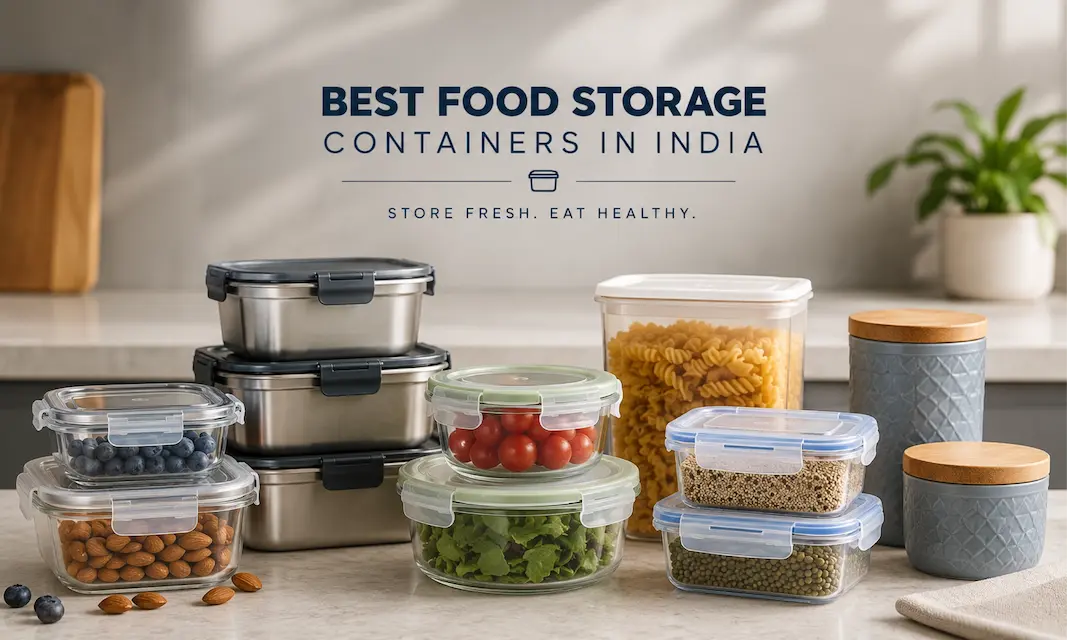
Best Food Storage Containers in India 2026

Leftover food stored in containers that allow moisture to seep in spoils within just two days. Furthermore, there are certain plastic containers that absorb food odors and stains so intensely that their color changes permanently. Glass containers that shatter if accidentally bumped against the kitchen sink and airtight containers that claim to keep food fresh but due to moisture start developing mold around the lid’s seal within just a few weeks.

Does all this seem familiar?

Some brands promise BPA-free plastic that keeps food fresh for weeks without absorbing odors, while others rely on high quality airtight sealing technology that completely blocks out moisture and air, keeping grains and spices dry even during the monsoon. Some prioritize food grade stainless steel construction, which prevents rust and the transfer of odors. Others focus on borosilicate glass, which is resistant to thermal shock and microwave safe, making it convenient to reheat food.

But do they really live up to their claims?

To provide you with the most accurate information, we conducted extensive research across Amazon India, Flipkart and other major Indian retailers which included reading hundreds of verified customer reviews. To compare the durability and airtightness of the materials, analyze actual usage in Indian kitchens and conduct an in-depth study of real-world buyer experiences across diverse climatic zones and family types.

Best Electric Razors for Men in India 2026

Our Top 5 Picks at a Glance


IKEA Food Storage Containers (Airtight BPA-Free)
Price: Rs. 399-802 (Set of 3-4 pieces)
Rating: 4.2/5 (1,200+ reviews)
Available: IKEA India, Amazon India, IKEA


Milton Storage Containers and Jars
Price: Rs. 249-499 (Individual containers; jars in sets)
Rating: 4.1/5 (1,450+ reviews)
Available: Amazon India, Flipkart, Milton


Tupperware Airtight Food Storage Containers
Price: Rs. 449-899 (Individual containers or sets)
Rating: 4.3/5 (1,850+ reviews)
Available: Amazon India, Tupperware Direct, Flipkart


Stainless Steel Storage Boxes
Price: Rs. 599-1,299 (Individual boxes; premium sets available)
Rating: 4.2/5 (980+ reviews)
Available: Amazon India


Borosil Glass Storage Containers
Price: Rs. 499-1080 (Individual containers; sets available)
Rating: 4.3/5 (1,600+ reviews)
Available: Amazon India, Flipkart & Borosil

Here are our honest findings:

IKEA Food Storage Containers (Airtight BPA-Free)

Price: Rs. 399-802 (Set of 3-4 pieces)
Rating: 4.2/5 (1,200+ reviews)
Available: IKEA India, Amazon India, IKEA

IKEA Food Storage Containers

IKEA’s food storage containers are currently proving to be the best and most versatile option for modern Indian kitchens. Their products for the Indian market are specifically designed to be airtight, leak-proof and ideal for keeping food fresh and safe. Consequently, they offer a highly suitable and comprehensive solution for families dealing with conditions such as India’s humid summers and monsoons, as well as the need for daily meal storage. These BPA-free plastic containers are available in various sizes, making them useful for a range of needs from storing kitchen leftovers to organizing pantry items.

IKEA products are characterized by a perfect blend of affordability, proven durability and practical design. Its airtight seal prevents moisture from entering a crucial feature in humid climates like India, where condensation often accumulates inside containers and leads to mold growth. Thanks to this transparent design, the contents are visible at a glance without opening the container, thereby minimizing exposure to dust and moisture. IKEA’s simple Scandinavian style complements modern Indian kitchens and at a price point of Rs. 399 to Rs. 802 (per set), it offers excellent value from a trusted global brand. These containers can be stacked on top of each other, allowing for the maximum utilization of valuable kitchen space a crucial consideration for Indian apartments and small kitchens.

Pros –

  • Certified BPA-free plastic ensures food safety for daily use; no chemical components leach into the food.
  • The airtight locking mechanism effectively prevents moisture seepage and the entry of insects.
  • The transparent design allows the contents to be viewed without opening the container, thereby reducing exposure to moisture.
  • The stackable design ensures optimal use of storage, ideal for space saving Indian kitchens.
  • Easy to clean; dishwasher-safe for convenient maintenance.
  • An excellent rating of 4.2/5 from over 1,200 verified Indian customers.
  • Affordable pricing of Rs. 399–802 for multi-piece sets; excellent value.
  • Widely available at IKEA India stores and on Amazon India, along with reliable after-sales service.

Cons –

  • Availability of a limited range of sizes compared to specialized brands.
  • If used for a long time with strongly scented substances, plastic containers can gradually absorb the odor.
  • With continuous use, the seals can deteriorate within 2–3 years, reducing airtightness.
  • Not suitable for very hot foods; the plastic may deform if exposed to direct heat.
  • The temperature range is not indicated; care must be taken when storing hot food.
IKEA Food Storage Containers

IKEA Food Storage Containers

Price: Rs. 399-802 (Set of 3-4 pieces)
Rating: 4.2/5 (1,200+ reviews)
Available: IKEA India, Amazon India, IKEA

Disclaimer : We are a product review website providing honest opinions based on extensive research. Prices mentioned are approximate and may vary.

Tupperware Airtight Food Storage Containers

Price: Rs. 449-899 (Individual containers or sets)
Rating: 4.3/5 (1,850+ reviews)
Available: Amazon India, Tupperware Direct, Flipkart

Tupperware Airtight Food Storage Containers

Tupperware’s airtight food storage containers focus on preserving food freshness and making daily kitchen management easy and reliable features that particularly appeal to Indian households. Tupperware India introduces these containers specifically for families seeking the durability of a trusted brand and reliable freshness technology. Their premium plastic construction is designed to preserve food quality for longer periods, making them ideal for Indian families who prepare meals in advance or store cooked food for several days.

Compared to ordinary plastic containers, Tupperware’s ‘airtight sealing’ technology has been specially developed to maintain the right level of moisture in food; this helps avoid issues such as food drying out common with traditional containers or spoiling due to humidity in Indian kitchens during the monsoon season. This brand boasts a legacy spanning decades in the food storage sector and this product represents the pinnacle of that expertise. For Indian families who prioritize reliability, durability, and the ability to keep food fresh, Tupperware stands out as a superior choice. These containers are ideal for storing dry snacks, spices, cooked vegetables and meal-prep ingredients perfectly meeting the diverse needs of the modern Indian kitchen.

Pros –

  • Premium airtight sealing technology preserves the freshness of food for a long time.
  • Engineered plastic offers longer-lasting protection against the absorption of odors and stains compared to ordinary plastic.
  • Available in various sizes (250 ml to 3 litres) to meet the diverse storage needs of Indian kitchens.
  • Durable design built for regular use over more than 10 years; highly beneficial in the long run.
  • Brand Reliability for decades, millions of Indian families have trusted Tupperware.
  • An excellent rating of 4.3/5 based on over 1,850 verified customer reviews.
  • Lifetime warranty options are available on select products (check specific models).
  • Widely available on Amazon and through direct Tupperware sellers.

Cons –

  • Regular maintenance and occasional replacement of seals are necessary for optimal performance.
  • Higher price compared to IKEA and ordinary plastic containers (Rs. 450–900 per piece/set).
  • Seals can harden due to aging and exposure to high temperatures, which affects their airtightness.
  • Over time, the plastic can develop microscopic scratches, creating fine cracks or crevices where unpleasant odors can accumulate.
  • Not microwave-safe (some models); must be transferred to another container for reheating.
Tupperware Airtight Food Storage Containers

Tupperware Airtight Food Storage Containers

Price: Rs. 449-899 (Individual containers or sets)
Rating: 4.3/5 (1,850+ reviews)
Available: Amazon India, Tupperware Direct, Flipkart

Disclaimer : We are a product review website providing honest opinions based on extensive research. Prices mentioned are approximate and may vary.

Milton Storage Containers and Jars

Price: Rs. 249-595 (Individual containers; jars in sets)
Rating: 4.1/5 (1,450+ reviews)
Available: Amazon India, Flipkart, Milton

Milton Storage Containers and Jars

Milton’s storage containers and jars are sturdy and stackable options that prove highly useful for organizing Indian kitchen supplies and are ideal for long term use. This brand focuses on transparent storage jars made from a combination of steel and glass, allowing for easy visibility of contents. This addresses a key need in Indian kitchens the ability to easily see and access kitchen staples such as rice, lentils, flour, spices and dry goods without repeatedly opening the containers.

Milton’s transparent storage jars are designed specifically for traditional Indian kitchens, where staples like grains, pulses and flours are stored for months. Their stackable design maximizes vertical storage space in compact Indian kitchens, while the transparent build eliminates the need for labeling or opening the containers to identify their contents. The steel lids remain tightly sealed even after years of use, and the overall construction is robust enough to withstand humid environments. For Indian families who prioritize keeping their kitchen organized and efficient, Milton offers practical utility at excellent value.

Pros –

  • The sturdy and stackable design maximizes vertical storage capacity in Indian kitchens with limited space.
  • Thanks to the clear glass or transparent plastic covering, the items inside can be seen without opening it.
  • Steel lids ensure reliable sealing, maintaining their shape even after prolonged use.
  • Highly durable products specially designed for storing dry food items in Indian kitchens.
  • Available in various sizes (500 ml to 2.5 litres) to meet all kitchen storage needs.
  • Highly affordable price range of Rs. 249–595; excellent value for long-term use.
  • An impressive rating of 4.1/5 from over 1,450 verified Indian customers.
  • Widely available on Amazon, Flipkart & Milton

Cons –

  • Due to metal lids and certain types of glass, it is not safe for use in the microwave.
  • In extremely humid kitchens, steel lids may develop rust or undergo discoloration over a period of 3–4 years.
  • Not suitable for storing wet or oily items; primarily designed for dry items.
  • Glassware can be heavy, and it requires careful handling to prevent breakage.
  • After prolonged use, the lids may become tight or difficult to open; therefore, it is necessary to lubricate them occasionally.
Milton Storage Containers and Jars

Milton Storage Containers and Jars

Price: Rs. 249-595 (Individual containers; jars in sets)
Rating: 4.1/5 (1,450+ reviews)
Available: Amazon India, Flipkart, Milton

Disclaimer : We are a product review website providing honest opinions based on extensive research. Prices mentioned are approximate and may vary.

Stainless Steel Storage Boxes

Price: Rs. 599-1,299 (Individual boxes; premium sets available)
Rating: 4.2/5 (980+ reviews)
Available: Amazon India

Stainless Steel Storage Boxes

Stainless steel storage containers are an excellent choice for Indian kitchens that prioritize durability, hygiene and long-term utility. Stainless steel is highly preferred for storage in Indian kitchens, its excellent qualities such as resistance to rust, the fact that it does not retain odors and its durability over time prove crucial in India’s humid and rainy climate. These containers are specially designed primarily for storing grains, dry snacks, puja essentials and leftovers situations where hygiene and preventing the transfer of odors are of utmost importance.

Unlike plastics that gradually absorb odors and stains or glass that can shatter, stainless steel preserves the quality and properties of food for a long time. The non-porous surface prevents bacterial growth and odor absorption, making it an excellent vessel for storing everything from rice and lentils to leftover curry and ready-made meals. For Indian families looking to invest in kitchenware that lasts for decades, stainless steel offers unmatched durability. Manufactured to commercial-grade standards, these utensils are equally effective in both professional kitchens and ordinary households a true testament to their robustness.

Pros –

  • Exceptional durability; designed to last for over 20 years, even in high-humidity environments.
  • Completely rust-resistant and corrosion-resistant in tropical and monsoon climates.
  • The non-porous surface prevents the absorption of odors—so even after storing strong-smelling foods, no lingering odor remains.
  • Highly hygienic; it inhibits bacterial growth and preserves food quality for a long time.
  •  Commercial-grade design suitable for both home and professional kitchens.
  • Available in airtight and traditionally sealed varieties; choose according to your needs.
  • An impressive rating of 4.2/5 from over 980 verified Indian customers.
  • Excellent for storing puja supplies, dry goods, and food items that require long-term storage.

Cons –

  • High price (Rs. 599–1,299); requires a large initial investment.
  • Heavier than plastic or glass; this requires sturdy shelves and careful handling.
  • Traditional seals may not be as airtight as modern silicone-sealed alternatives.
  • Due to the opaque structure, the contents inside cannot be seen without opening it.
  • Not microwave-safe; must be transferred to another container for reheating.
  • Water stains or fingerprints may appear on the surface, necessitating regular polishing.
Stainless Steel Square Kitchen Containers Set of 3 Pcs

Stainless Steel Storage Boxes

Price: Rs. 599-1,299 (Individual boxes; premium sets available)
Rating: 4.2/5 (980+ reviews)
Available: Amazon India

Disclaimer : We are a product review website providing honest opinions based on extensive research. Prices mentioned are approximate and may vary.

Borosil Glass Storage Containers

Price: Rs. 499-1080 (Individual containers; sets available)
Rating: 4.3/5 (1,600+ reviews)
Available: Amazon India, Flipkart & Borosil

Borosil Glass Storage Containers

Glass storage containers from brands like Borosil are an excellent choice for the convenience of reheating food and keeping the refrigerator organized. In storage guides focused on India, glassware is increasingly being recommended to meet the needs of the modern Indian lifestyle offering visibility, odor resistance and microwave-friendly convenience. The borosilicate glass composition provides resistance to thermal shock meaning you can move the cookware from the freezer to the microwave without worrying about it cracking or shattering.

These containers solve a major problem in Indian kitchens: the need to reheat leftovers throughout the day. Unlike plastic containers that cannot be used directly in the microwave or steel containers that require the food to be placed in another container, glass containers eliminate this extra hassle. The non-porous glass surface does not absorb the odors of pungent Indian style ‘kadhi’ or ‘dal’, thereby preserving the food’s original quality for a long time. For Indian families who prep ingredients or store leftover vegetables in the fridge, these containers offer unparalleled convenience. Their transparency allows for quick identification of contents and the glass surface remains pristine unlike plastic containers, they do not become discolored or stained after storing turmeric-laden dishes for months on end.

Pros –

  • Microwave-safe for direct reheating — so there is no need to transfer the contents to another vessel.
  • Borosilicate glass withstands extreme temperature changes (thermal shock) excellently without cracking.
  • A non-porous surface never absorbs odors so pungent curry leaves can be stored without leaving any lingering smell.
  • 100% odor- and stain-resistant; the containers remain transparent and clean even after years of use.
  • The contents are clearly visible; the transparency helps with meal planning and inventory management.
  • Dishwasher-safe and easy to clean; food particles do not stick to it like they do to plastic.
  • An excellent rating of 4.3/5 from over 1,600 verified Indian customers.
  • Ideal for fridge organization, meal prep, and packing lunch boxes.
  • Safe for freezer storage; food can be stored for a long time without significant deterioration in quality.

Cons –

  • Due to its shape, it occupies more space in the cupboard; storage efficiency is lower compared to stackable plastic containers.
  • Heavier than plastic containers; careful handling is required to prevent breakage.
  • Higher price (Rs. 499–999) compared to simple plastic alternatives.
  • It can break if dropped on the hard floor of the kitchen; its durability depends on careful handling.
  • Due to thermal mass (the property of retaining heat), it takes longer to heat up or cool down compared to plastic.
  • Compared to glass containers, their lids (which are often made of plastic) can deteriorate more quickly.
Borosil Glass Storage Containers

Borosil Glass Storage Containers

Price: Rs. 499-1080 (Individual containers; sets available)
Rating: 4.3/5 (1,600+ reviews)
Available: Amazon India, Flipkart & Borosil

Disclaimer : We are a product review website providing honest opinions based on extensive research. Prices mentioned are approximate and may vary.

Everything You Need to Know About Choosing Food Storage Containers for Indian Kitchens

Comparing Storage Container Materials: Which Is Best for Your Needs?

Plastic containers (IKEA, Tupperware) – BPA-free plastic is lightweight and affordable, and is useful for storing dry fruits or grains, leftovers and prepared food.  

Advantages – Lightweight, affordable, available in various shapes, stackable, and durable for 5–10 years.

Disadvantages –  It absorbs odors and stains over time, its shape can change due to hot food, and the seals deteriorate over time.

Stainless steel cookware ‘Food-grade’ steel offers exceptional durability, corrosion resistance and the quality of not absorbing food odors.

Benefits: Lasts for over 20 years, is completely rust resistant, prevents the absorption of odors and is highly hygienic.

Disadvantages: Heavier, more expensive, opaque (contents are not visible) not microwave safe and requires careful handling.

Glass containers (Borosil or similar) –  Borosilicate glass is microwave safe and heat-resistant, making it excellent for reheating food. Advantages: Safe for use in microwaves and freezers, does not absorb odors, remains transparent, easy to clean, and dishwasher safe. Disadvantages: Heavier than plastic, prone to breaking if dropped, more expensive and takes longer to heat up.

For Indian kitchens, adopting a hybrid approach proves to be the best.

  • Plastic containers (IKEA/Tupperware) for daily storage and meal prep.
  • Stainless steel containers for long-term storage of dry foods and strong-smelling items
  • Glass containers for reheating leftovers and organizing items in the fridge.
  • Steel-lidded jars (Milton-style) for storing kitchen supplies and keeping them easily visible.

Understanding Airtight Sealing Technology

Airtight containers prevent the exchange of air and moisture, keeping food fresh for longer and blocking the entry of insects; this is particularly important in humid climates like India’s.

Airtight containers with silicone seals: These utilize flexible silicone gaskets, creating a complete hermetic seal when the lid is pressed shut. Advantages: Reliable protection against moisture, prevention of pest entry and preservation of food freshness for several weeks. Disadvantages: The seals may harden or crack after        3 to 4 years, requiring occasional replacement.

Snap-lock or click-seal technology: This utilizes interlocking mechanisms to create a tight seal without the need for separate gaskets. Advantages: Simple and durable, fewer parts prone to failure and consistent long-term performance. Disadvantages: In humid weather, this technology may not be as airtight as options featuring silicone seals.

Vacuum-sealed containers: These are high-quality options that create a vacuum upon sealing, removing air from the container. Advantages: They effectively preserve freshness and provide protection against moisture. Disadvantages: They are expensive, require careful handling to maintain the seal and are less convenient for daily use.

Recommendation for the Indian climate: For India’s humid climate, silicone sealed containers strike the best balance between airtightness and durability. Instead of relying on general claims, choose containers that explicitly state “airtight with silicone seal.”

Choosing the Right Size and Number of Containers

Small containers (250–500 ml) – These are extremely useful for storing spices, herbs, small amounts of leftover food and items for children’s lunchboxes. An Indian kitchen typically requires about 6–8 small containers for daily use.

Medium-sized containers (500 ml – 1 litre) – These are excellent for storing cooked vegetables, curries, rice and snacks. Having 4 to 6 medium-sized containers proves useful in most households for storing food items.

Large containers (1–2 litres) –  Useful for storing large quantities of dry goods, flour, lentils and pre-prepared meals. Generally, 3–4 large containers are needed for staple kitchen ingredients.

Extra-large containers (2.5–3 litres or larger) – for large stocks of grains, rice and food items meant for long-term storage. Typically, every household has one or two such containers.

For typical Indian families, a set of 12–16 containers of various sizes (a starter set) usually suffices to meet daily needs. This not only facilitates food storage but also allows for the organized arrangement of kitchen supplies, preventing unnecessary clutter.

Storage Container Considerations for India’s Climate

Humidity Management – India’s high humidity levels (60–85% in coastal areas and 70–90% during the monsoon) present specific challenges. It is essential to use airtight containers with silicone seals to prevent moisture ingress and mold growth. Avoid stacking non-airtight containers, as moisture accumulating between the layers can spoil the contents.

Monsoon Storage –  During the monsoon season (June to September), it is crucial to use airtight metal or plastic containers to protect dry items like rice, flour and lentils from moisture. Glass containers are also excellent for this purpose, as they do not absorb moisture from the air.

Temperature fluctuations –  India experiences significant seasonal temperature variations (ranging from 10°C in winter to 45°C in summer). Containers must withstand these temperature differences without warping or cracking. Glass and steel containers handle temperature fluctuations exceptionally well.

Pest Prevention – High humidity and warm temperatures create an environment conducive to the proliferation of pests and rodents. Using airtight containers prevents pest entry and ensures food safety. Steel and glass containers are particularly effective for this purpose, as pests cannot gnaw through them to gain access.

Preventing mold growth –  Mold can grow on the seals of containers kept in dark, damp areas of the kitchen. Choose containers with removable seals (such as Tupperware) for easier cleaning. Store containers in a well-ventilated area and ensure they are completely dry before closing them.

Addressing Common Food Storage Issues in Indian Kitchens

Strong food odors – Indian cooking involves the use of aromatic spices (such as turmeric, asafetida and garlic), the odors of which can linger on plastic containers. Solution: Use stainless steel or glass containers for dishes like ‘amti’ (lentil curry), ‘rassa-bhaji’ (curried vegetables) or other strongly scented foods. If you do use plastic containers, wash them with lemon juice or baking soda to eliminate any lingering odors.

Discoloration of plastic – Turmeric and other spices cause yellow or orange stains on plastic containers. Solution: Use glass or steel vessels for curries. If using plastic containers, coat them with oil before storing foods containing turmeric to minimize staining.

Accumulation of moisture and condensation –  Placing hot food in sealed containers leads to condensation, which promotes mold growth. Solution: Allow the food to cool to room temperature before sealing the container. Do not put the lid on while the food is still hot. In humid weather, wipe away any excess moisture from the container before closing it.

Mold growth on seals – Mold grows on rubber seals due to hot and humid weather, especially during the monsoon. Solution: Remove the seals once a week and clean them with white vinegar. Store containers in a dry place with their lids left open. Replace the seals every 2–3 years.

Limited freezer space –  Storing numerous containers in the refrigerator creates a space crunch. Solution: Choose stackable containers. Use tall, upright jars. Consider layering your storage. Glass and plastic containers are easier to stack than steel ones.

Frequently Asked Questions

Q: What is the best all-around food storage container for Indian kitchens?

– IKEA food storage containers are an excellent choice for most Indian households. They strike a perfect balance between affordability (Rs. 399–599 per set), reliable airtight sealing, BPA-free safety and durability even in humid weather. Their transparent design allows the contents to be seen at a glance, while their stackable nature saves valuable kitchen space. With a 4.2/5 rating from over 1,200 Indian customers, this product is considered reliable across the country.

Q: Which container is best for storing strong-smelling Indian foods like curries?

– Glass (Borosil-type) or stainless steel containers are the best options for you. Since the surfaces of both types of containers are non-porous, they do not absorb odors; consequently, storing a dish like *kadhi* or a curry in one today will not affect the food stored in it tomorrow. If you plan to reheat curry in the microwave, a glass container is more convenient. Stainless steel is preferable for the long-term storage of dishes like lentils, as the container’s non-porous nature and durability are crucial in such cases.

Q: How do I prevent mold growth on container seals during monsoon season?

– Fungi grow rapidly in the warm and humid weather experienced in India during the monsoon season (June to September). To prevent this: (1) Once a week, remove the seals from the containers and clean them with white vinegar. (2) Ensure the containers are completely dry before sealing. (3) Do not stack airtight containers in damp cupboards; keep their lids open when they do not contain food. (4) Store the container in a well-ventilated place. (5) Replace the rubber seals every 2–3 years, as they deteriorate over time. Brands like Tupperware offer a seal replacement facility, making them suitable for monsoon conditions.

Q: Are plastic containers safe for storing hot foods?

– Not recommended. Most plastic containers including BPA-free options can warp or leach chemicals when exposed to temperatures exceeding 60°C. Furthermore, when hot food is stored in airtight plastic containers, the resulting vapor promotes bacterial growth and mold formation. Always allow food to cool to room temperature before sealing it in plastic. Instead, use glass (microwave-safe) or stainless steel containers to store hot food.

Q: Should I invest in premium Tupperware or go with affordable IKEA containers?

– It depends on your usage habits and budget. If you want low-maintenance containers that last for over 10 years and can afford the higher price, then ‘Tupperware’ (Rs. 450–900 per container) is an excellent choice. For families conscious of their budget who do not mind replacing their containers every 5–7 years, IKEA is an excellent option (costing Rs. 100–150 per container as part of a set). Many Indian families use both: IKEA for daily use and Tupperware as a long-term investment for specific items like grains or spices.

Q: Can I use glass containers in the freezer?

– Yes, borosilicate glassware such as Borosil is safe to use in the freezer. Thanks to its thermal shock resistance, the glass does not crack when moved from the freezer to room temperature or into the microwave. However, avoid using standard (non-borosilicate) glass bottles, as they can break. Never fill glass containers completely when freezing; leave 1–2 cm of space to allow for food expansion. Ensure that you are specifically using borosilicate glass, as indicated on the label.

Q: What’s the ideal number and variety of containers for an Indian household?

– A practical ‘starter set’ includes these: (1) 6–8 small containers (250–500 ml) for spices, snacks and specific portions of food. (2) 4–6 medium-sized containers (500 ml to 1 litre) for daily leftovers and cooked food. (3) 3–4 large containers (1–2 litres) for bulk storage and prepared meals. (4) 1–2 extra-large containers (with a capacity of more than 2.5 litres) for kitchen staples like rice and flour. You will need a total of 14 to 20 containers to meet household needs. For best results, use containers made from various materials: lightweight plastic for daily use, glass for reheating food and steel for long-term storage.

Q: How often should I replace my food storage containers? – Plastic containers (e.g., IKEA and Tupperware) generally last for 5–7 years before their seals deteriorate or the problem of odor absorption arises. If glass vessels do not break, they can last indefinitely. Stainless steel vessels last for more than 20 years. To ensure optimal food safety: inspect the seals annually, replace any containers that have become discolored or developed an odor and replace the seals every 2–3 years in humid weather. Choosing products from quality brands means you won’t need to replace them frequently.

Disclaimer: We are a product review website providing honest opinions based on extensive research and real-world usage analysis. Prices mentioned are approximate and may vary based on sales, offers, and location.