
Best Dishwashers in India 2026
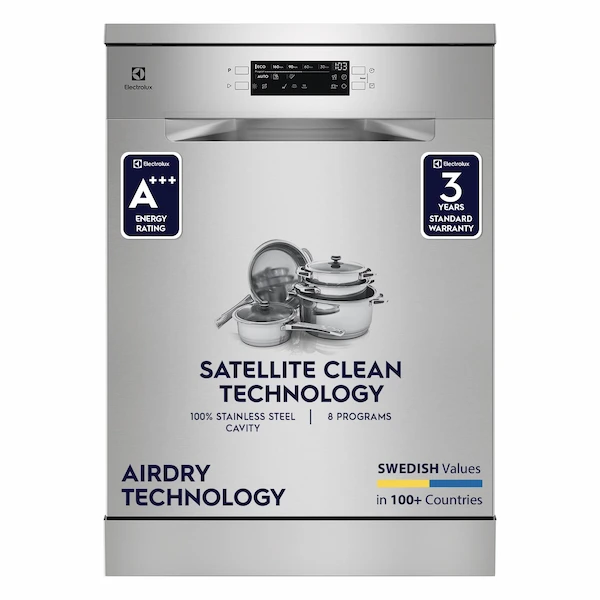
Electrolux Ultimate Care 700 Dishwasher
Place Settings: 14 — large families
Key Indian Feature: SprayZone for heavy cookware + ExtraHygiene 70°C
Water per Cycle: ~10 litres
Noise Level: 46 dB
Special Feature: SatelliteClean + Anti-Flood Protection + 3-Stage Filter
Capacity: 14 Place Settings
Rating: 4.3 ★★★★☆
Price: Rs.48,000 – Rs.61,990
What We Like –
Its SprayZone feature is the most distinctive feature of this technique. It allows you to direct additional water pressure directly to the lower rack, where your wok, pressure cooker, and heavy utensils are stored. Instead of applying intense pressure to the entire machine (which risks damaging the glassware stored in the upper rack), SprayZone intelligently directs water intensity exactly where it’s needed. The SatelliteClean system keeps the water continuously accumulating throughout the cycle, preventing stagnant water pockets where stubborn food particles can stick back to utensils.
The SoftGrips and SoftSpikes built into the rack’s design securely hold glassware, preventing direct contact between the metal and glass, which can cause minor scratches on the glass over time. If you have high-quality glassware, this is more valuable than most buyers think, unless they find their first damaged item.
Features like its ExtraHygiene Cycle, 3-stage filtration system, and anti-flood protection make this machine far more versatile than most machines at this price. The 24-hour delay start timer is the best in our comparison study, giving you complete flexibility to schedule your washing to suit your day.
What Could Be Better –
Electrolux’s service network in India, despite improvements, is more limited than that of IFB or Bosch in non-metro cities. Parts availability means repairs can sometimes take a little longer. The premium price puts it above Faber and IFB without offering commensurately better performance for standard Indian cooking scenarios.
Priced at Rs. 48,000-55,000, the UltimateCare 700 falls into the mid-to-premium range, but doesn’t have the brand recognition of Bosch or the robust service network of IFB. For shoppers in this price range, Bosch’s Indian cooking programs, available at roughly the same price, may be a better option, unless the SprayZone feature and glassware protection are their main priorities.
Unlike IFB, Electrolux does not have an in-built water softener. In cities with hard water, regular descaling and consistent use of dishwasher salt is required to maintain good performance over the long term.
Real Talk –
The Electrolux UltimateCare 700 is for customers who want a premium kitchen that offers premium look and function – where the dishwasher doesn’t just clean dishes, it also cares for them. If you have high-quality glassware, if you regularly cook a variety of meals in complex dishes, and if you want a machine that looks and works like new even after years of regular use, the UltimateCare 700 gives you that experience. The SprayZone feature is genuinely amazing, the build quality is excellent, and the ExtraPower’s results at cleaning stubborn Indian food residue are among the best in this price range. Be sure to check service coverage in your city before purchasing – the excellence of this machine depends on its maintenance.
Electrolux Ultimate Care 700 Dishwasher
Place Settings: 14 — large families
Key Indian Feature: SprayZone for heavy cookware + ExtraHygiene 70°C
Water per Cycle: ~10 litres
Noise Level: 46 dB
Special Feature: SatelliteClean + Anti-Flood Protection + 3-Stage Filter
Capacity: 14 Place Settings
Rating: 4.3 ★★★★☆
Price: Rs.48,000 – Rs.61,990
Disclaimer : We are a product review website providing honest opinions based on extensive research. Prices mentioned are approximate and may vary.
How to Choose the Right Dishwasher for Your Indian Kitchen?
1. Place Settings — The Most Misunderstood Specification
“Place settings” refers to the number of full place settings (plate, bowl, glass, cutlery) the machine can hold. But Indian cooking generates more cookware than this calculation accounts for. A family of 4 running a full Indian kitchen — with kadhais, pressure cookers, serving bowls, tawas, and steel plates — will realistically need 12–15 place settings even with only 4 members.
- Family of 2–3 people: 12 place settings sufficient
- Family of 4–5 people: 14–15 place settings recommended
- Joint family of 6+: look for 15–16 place settings, or run two cycles
2. Water Consumption — The Number That Changes Everything
This is the specification that converts most sceptics. The average Indian household uses 40–60 litres of water hand-washing a full day’s dishes. A modern dishwasher uses 9–12 litres for the same load. Over a year, with one full cycle per day, that is a saving of approximately 11,000–18,000 litres — equivalent to 180–300 overhead tank refills in a city apartment.
In cities where water costs Rs.5–10 per kilolitre and where supply is irregular, this is not just environmentally responsible — it is financially significant.
3. Hard Water Compatibility — Critical for Most Indian Cities
TDS (Total Dissolved Solids) levels above 300 ppm are considered hard water. Most Indian metro cities — Delhi (400–600 ppm), Mumbai (200–350 ppm), Bengaluru (150–300 ppm), Chennai (300–500 ppm) — fall in or above this range. Hard water leaves white calcium deposits on dishes and scale build-up inside the machine that reduces lifespan.
- Built-in water softener
- Salt-based regeneration
- Basic protection
4. Indian Cooking Programs — Non-Negotiable
A dishwasher without an Intensive or Kadhai program at 65–70°C is the wrong dishwasher for an Indian kitchen. Standard European programs are calibrated for pasta sauce and roast drippings — not masala, turmeric, ghee, or the sticky residue of caramelized onions. Verify that your chosen machine has at minimum a 70°C intensive program before purchase.
5. Noise Levels — More Relevant Than You Think
Indian apartments have open kitchen-living room layouts increasingly common in modern design. A machine running at 49 dB is audible in the adjacent room during a quiet evening. Machines at 44 dB blend into background household noise. If your kitchen is adjacent to a bedroom or living area where conversation or television are normal, prioritize machines at 44–46 dB.
6. After-Sales Service — The Specification Nobody Lists
When a Rs.50,000 appliance stops working on a Sunday evening, what matters is how quickly and easily you can get it repaired. Check the brand’s service centre coverage in your specific city before purchase — not just the top 10 metros.
- Best service network
- Strong metro service
- Growing coverage
Frequently Asked Questions (FAQs)
1. Are dishwashers truly worth buying in India?
Yes — more now than ever. A modern dishwasher uses one-fifth the water of hand-washing, cleans at 70°C temperatures that hands cannot tolerate (killing bacteria more effectively), and frees 30–45 minutes per day. Over a 10-year lifespan, the water savings alone offset a significant portion of the purchase cost in most cities.
2. Can Indian utensils like kadhais, pressure cookers, and tawas go in a dishwasher?
Most stainless steel, tempered glass, and ceramic utensils are dishwasher-safe. Cast iron, non-stick coated items, copper utensils, and items with wooden handles should be hand-washed. All five machines in our list have programs specifically calibrated for heavy Indian cookware — but check individual utensil manufacturer guidance for certainty.
3. How much does it cost to run a dishwasher daily in India?
A standard cycle uses approximately 1.0–1.5 kWh of electricity and 9–12 litres of water. At average Indian electricity rates (Rs.6–8 per unit) and water costs, daily running cost is approximately Rs.8–15 — less than Rs.400 per month. Factor in detergent (Rs.3–5 per cycle using dishwasher tablets) and total daily operating cost is roughly Rs.12–20.
4. What detergent should I use?
Always use detergent specifically formulated for dishwashers — tablets, gel, or powder labelled as “dishwasher detergent.” Regular dish soap creates excessive foam that damages the machine and reduces cleaning performance. Popular options in India include Finish Quantum tablets, Rin Dish wash tablets, and Prill Dishwasher gel. Use rinse aid alongside detergent for best drying results.
5. Does a dishwasher need professional installation?
Yes. Dishwashers require connection to a water supply line (inlet hose), a drain line, and a dedicated electrical point. All five brands in our list offer free installation with purchase. Professional installation ensures proper levelling, leak-free connections, and correct placement of the drain hose to prevent backflow. Do not attempt self-installation unless you have plumbing experience.
6. How do I maintain a dishwasher to ensure long life?
Run a monthly cleaning cycle with a dishwasher cleaner tablet (Finish Machine Cleaner works well). Clean the filter every 2–4 weeks by removing it and rinsing under the tap. Check the spray arms monthly for blocked jets. Leave the door slightly ajar after cycles to allow the interior to dry fully and prevent mildew. Refill rinse aid and salt (where applicable) as indicated by the machine’s indicator lights.
Disclaimer: We are a product review website providing honest opinions based on extensive research and real-world usage analysis. Prices mentioned are approximate and may vary based on sales, offers, and location.