
Best Dishwashers in India 2026
IFB Neptune VX Plus Dishwasher
Place Settings: 16 — great for joint families
Key Indian Feature: Hot Water Wash 70°C + Built-in Water Softener
Water per Cycle: ~10 litres
Noise Level: 46 dB
Special Feature: 360° Anti-Microbial Filter + Steam Drying
Capacity: 16 Place Settings
Rating: 4.3 ★★★★☆
Price: Rs.53,990 – Rs.63,090
What We Like –
If you live in Delhi, Mumbai, Bangalore, or any other city where the TDS level in tap water often exceeds 500 ppm, you know the impact that hard water has on utensils. It leaves a white film on utensils, dulls steel plates, and shortens the life of any appliance it passes through. IFB’s in-built water softener solves this problem simply by treating the water before it reaches the utensils, preventing scale build-up on both utensils and machinery.
Washing with hot water at 70°C isn’t just about cleaning, it also kills germs. At 70°C, bacteria, viruses, and fungi are destroyed by up to 99.9%. This information is especially useful for injured children, the elderly, or those with compromised immune systems.
The 360° Active Anti-Microbial Filter keeps the water clean throughout the entire wash cycle, preventing any cross-contamination from the first vessel to the last. Steam Drying ensures that vessels come out completely dry – there’s no need to wipe with a towel, reducing the transfer of bacteria from the cloth to the clean vessels.
It includes 8 wash programs, including Eco-Wash, Light Soiled, Super 50-Minute, Pots & Pans 65°C, Quick Wash and half load – which cater to the needs of almost every Indian kitchen, including a program specially designed for pressure cooker air-loaded utensils.
What Could Be Better –
Its noise level of 46 dB is slightly higher than that of the Bosch and LG, although it still makes less noise than washing hands with running water. Cycle times for intensive programs can be as long as 90-120 minutes, which may seem long to first-time users.
Intensive wash cycles can run for 90-120 minutes, which may seem a bit long to first-time dishwasher users who expect quick results. You get a thorough clean in return, but you’ll need to adjust your routine and preload the machine early enough to run it.
It’s control panel, while functional, isn’t as intuitive as Bosch’s cleaner display designs. It may take a few days for first-time users to get comfortable with program selection, especially with the range of 8 wash programs available.
Real Talk –
The IFB Neptune VX Plus is the most practical Indian dishwasher on this list. It wasn’t designed in Germany and adapted for India – it was designed keeping in mind India’s actual water supply, cooking habits, and service needs. If you live in a city with water scarcity (i.e., most urban areas in India), the included water softener justifies choosing IFB over its competitors. Add the country’s widest service network and excellent hygiene washing at 70°C, and you have a machine that can be compared to real Indian markets much more easily than any specification sheet. This is the machine we’d recommend to parents buying a dishwasher for the first time.
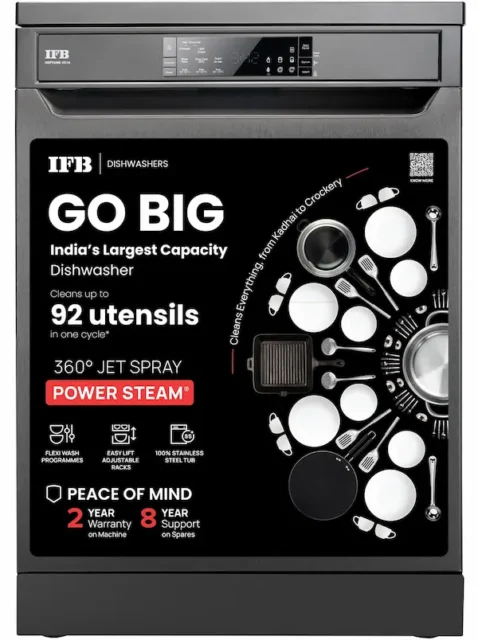
IFB Neptune VX Plus Dishwasher
Place Settings: 16 — great for joint families
Key Indian Feature: Hot Water Wash 70°C + Built-in Water Softener
Water per Cycle: ~10 litres
Noise Level: 46 dB
Special Feature: 360° Anti-Microbial Filter + Steam Drying
Capacity: 16 Place Settings
Rating: 4.3 ★★★★☆
Price: Rs.53,990 – Rs.63,090
Disclaimer : We are a product review website providing honest opinions based on extensive research. Prices mentioned are approximate and may vary.
How to Choose the Right Dishwasher for Your Indian Kitchen?
1. Place Settings — The Most Misunderstood Specification
“Place settings” refers to the number of full place settings (plate, bowl, glass, cutlery) the machine can hold. But Indian cooking generates more cookware than this calculation accounts for. A family of 4 running a full Indian kitchen — with kadhais, pressure cookers, serving bowls, tawas, and steel plates — will realistically need 12–15 place settings even with only 4 members.
- Family of 2–3 people: 12 place settings sufficient
- Family of 4–5 people: 14–15 place settings recommended
- Joint family of 6+: look for 15–16 place settings, or run two cycles
2. Water Consumption — The Number That Changes Everything
This is the specification that converts most sceptics. The average Indian household uses 40–60 litres of water hand-washing a full day’s dishes. A modern dishwasher uses 9–12 litres for the same load. Over a year, with one full cycle per day, that is a saving of approximately 11,000–18,000 litres — equivalent to 180–300 overhead tank refills in a city apartment.
In cities where water costs Rs.5–10 per kilolitre and where supply is irregular, this is not just environmentally responsible — it is financially significant.
3. Hard Water Compatibility — Critical for Most Indian Cities
TDS (Total Dissolved Solids) levels above 300 ppm are considered hard water. Most Indian metro cities — Delhi (400–600 ppm), Mumbai (200–350 ppm), Bengaluru (150–300 ppm), Chennai (300–500 ppm) — fall in or above this range. Hard water leaves white calcium deposits on dishes and scale build-up inside the machine that reduces lifespan.
- Built-in water softener
- Salt-based regeneration
- Basic protection
4. Indian Cooking Programs — Non-Negotiable
A dishwasher without an Intensive or Kadhai program at 65–70°C is the wrong dishwasher for an Indian kitchen. Standard European programs are calibrated for pasta sauce and roast drippings — not masala, turmeric, ghee, or the sticky residue of caramelized onions. Verify that your chosen machine has at minimum a 70°C intensive program before purchase.
5. Noise Levels — More Relevant Than You Think
Indian apartments have open kitchen-living room layouts increasingly common in modern design. A machine running at 49 dB is audible in the adjacent room during a quiet evening. Machines at 44 dB blend into background household noise. If your kitchen is adjacent to a bedroom or living area where conversation or television are normal, prioritize machines at 44–46 dB.
6. After-Sales Service — The Specification Nobody Lists
When a Rs.50,000 appliance stops working on a Sunday evening, what matters is how quickly and easily you can get it repaired. Check the brand’s service centre coverage in your specific city before purchase — not just the top 10 metros.
- Best service network
- Strong metro service
- Growing coverage
Frequently Asked Questions (FAQs)
1. Are dishwashers truly worth buying in India?
Yes — more now than ever. A modern dishwasher uses one-fifth the water of hand-washing, cleans at 70°C temperatures that hands cannot tolerate (killing bacteria more effectively), and frees 30–45 minutes per day. Over a 10-year lifespan, the water savings alone offset a significant portion of the purchase cost in most cities.
2. Can Indian utensils like kadhais, pressure cookers, and tawas go in a dishwasher?
Most stainless steel, tempered glass, and ceramic utensils are dishwasher-safe. Cast iron, non-stick coated items, copper utensils, and items with wooden handles should be hand-washed. All five machines in our list have programs specifically calibrated for heavy Indian cookware — but check individual utensil manufacturer guidance for certainty.
3. How much does it cost to run a dishwasher daily in India?
A standard cycle uses approximately 1.0–1.5 kWh of electricity and 9–12 litres of water. At average Indian electricity rates (Rs.6–8 per unit) and water costs, daily running cost is approximately Rs.8–15 — less than Rs.400 per month. Factor in detergent (Rs.3–5 per cycle using dishwasher tablets) and total daily operating cost is roughly Rs.12–20.
4. What detergent should I use?
Always use detergent specifically formulated for dishwashers — tablets, gel, or powder labelled as “dishwasher detergent.” Regular dish soap creates excessive foam that damages the machine and reduces cleaning performance. Popular options in India include Finish Quantum tablets, Rin Dish wash tablets, and Prill Dishwasher gel. Use rinse aid alongside detergent for best drying results.
5. Does a dishwasher need professional installation?
Yes. Dishwashers require connection to a water supply line (inlet hose), a drain line, and a dedicated electrical point. All five brands in our list offer free installation with purchase. Professional installation ensures proper levelling, leak-free connections, and correct placement of the drain hose to prevent backflow. Do not attempt self-installation unless you have plumbing experience.
6. How do I maintain a dishwasher to ensure long life?
Run a monthly cleaning cycle with a dishwasher cleaner tablet (Finish Machine Cleaner works well). Clean the filter every 2–4 weeks by removing it and rinsing under the tap. Check the spray arms monthly for blocked jets. Leave the door slightly ajar after cycles to allow the interior to dry fully and prevent mildew. Refill rinse aid and salt (where applicable) as indicated by the machine’s indicator lights.
Disclaimer: We are a product review website providing honest opinions based on extensive research and real-world usage analysis. Prices mentioned are approximate and may vary based on sales, offers, and location.